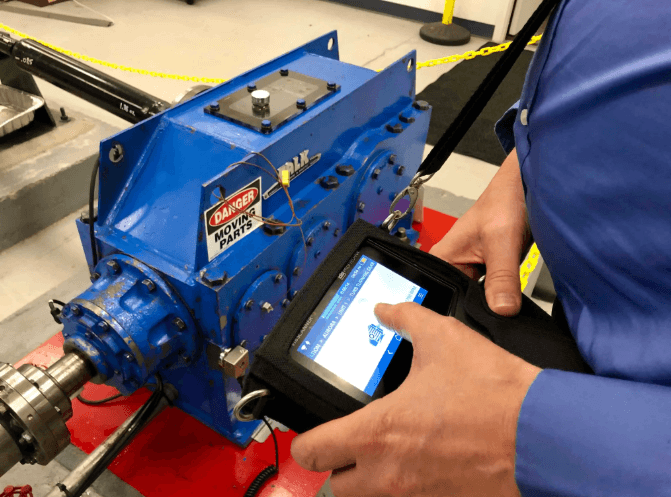
Modern industrial systems require greater reliability, less downtime, and better asset management. Traditional methods of maintenance have become inadequate to meet these requirements, particularly in industries where machines rotate at high speeds. Advanced vibration analysis has proven to be an invaluable technique for helping technicians analyze machines and make sound judgments regarding maintenance and machine behavior. With the aid of these techniques, companies can move from reactive maintenance to proactive maintenance. This chapter examines five advanced techniques used for maintenance.
Condition-Based Maintenance (CBM) Using Real-Time Monitoring
Condition-based maintenance uses the constant or regular observation of machine health status to decide the timing for maintenance operations. Modern vibration tracking is a key component of this technique because vibration data are used to gauge machine condition. Vibration sensors placed on the machines record vibration signatures, which are then analyzed to look out for any anomalies compared to normal performance levels. The maintenance operation is carried out only when signs of degradation are noted; therefore, condition-based maintenance eliminates unnecessary maintenance operations, saves money, and prevents sudden failures. With the help of oscillation analysis, technicians can notice imbalances, misalignments, worn-out bearings, and looseness.
Predictive Maintenance Through Data Analytics and Machine Learning
Predictive maintenance expands on the benefits of vibration monitoring by incorporating historical information, statistical calculations, and machine learning tools into predicting equipment breakdowns before they happen. Vibration data is continually analyzed to find small trends that cannot be easily detected using traditional methods. The results are then matched with the expected modes of failure to predict how long equipment will last and plan maintenance activities accordingly. Companies that spend money on high-quality vibration tracking software that offers predictive maintenance capabilities can gain significant improvements in equipment efficiency while minimizing downtime. Predictive models can be fine-tuned over time as more data becomes available.
Fault Detection and Diagnostics for Root Cause Identification
Modern advanced vibration analysis is highly effective for diagnosing specific mechanical faults within rotating equipment. With the aid of frequency spectra and waveforms, the technician will be able to determine the nature of the problem at hand, whether it is a problem with the bearing, the gears, the resonance effect, or a shaft alignment problem, among others. Different problems will result in different waveforms; therefore, by knowing the waveform that has been generated, it will be easy to find out the cause of the problem. This way, the need for trial and error is minimized, and recurrence of failures is prevented. It becomes possible to solve the real problem and not treat its symptoms.
See also: How Technology Fuels Entrepreneurial Growth
Proactive Maintenance Through Trend Analysis and Early Warning Systems
Proactive maintenance involves being aware of the early symptoms of deterioration that precede any breakdowns occurring. Vibration trend analysis plays an integral role in this process as it entails monitoring vibration trends and detecting deviations. Early warning systems can be programmed to detect when thresholds have been crossed or when abnormal vibration patterns occur. There is sufficient warning to allow for proactive action to take place. In addition, through analyzing vibration trends over an extended period, it becomes possible to pinpoint recurrent problems, which can then be rectified through changes in design and operation procedures.
Reliability-Centered Maintenance (RCM) Integrated with Vibration Insights
Reliability-centered maintenance focuses on choosing the best possible maintenance plan for every asset, depending on its importance and failure modes. Vibration monitoring provides a lot of useful information that helps in making such choices by showing how assets operate under various conditions. With vibration data incorporated into reliability-centered maintenance, companies can focus on maintenance activities that are necessary in terms of risk and impact, instead of using the same approach to manage every asset. For example, highly critical assets that are sensitive to vibrations might need more attention than others, whereas other, less critical assets would benefit from basic management techniques.Vibration analysis has brought about revolutionary changes in the maintenance process through its ability to bring out more informed approaches. Condition-based, predictive, fault detection, proactive, and reliability maintenance are some of the approaches that employ oscillation analysis to improve decision-making and efficiency. As industries become more digitalized with time, vibration tracking shall always be at the heart of every maintenance program. Companies that integrate these techniques into their operations enjoy increased machine reliability and a competitive advantage.